
Brule Criminal History Checks
A Brule record search starts with the agency that took action. No village police portal or municipal docket was found. The Keith County Sheriff is often the practical local contact, while NSP keeps its own highway reports. Keith County Jail handles bookings, county clerks hold filed cases, and NSP PCH supplies a Nebraska-wide fingerprint-supported history. Compare those sources because none is a full copy of the others.
Use the current custody route first for a new Brule arrest. Move to the court and statewide sources once filing and disposition data have had time to arrive.
- Identify the sheriff, NSP, or another agency on the Brule report or citation.
- Request its incident or arrest report with a narrow date, place, and report number.
- Search JUSTICE under Keith County for ordinance, misdemeanor, or felony court records.
- Use the jail roster or call 308-284-4772 for current custody and booking facts.
- Order NSP PCH when Nebraska-wide fingerprint-supported history is needed.
Brule Records Follow the Report
No separate Brule police records unit, official app, arrest log, or online report request was verified. Read the agency name on the citation, crash sheet, report, or booking paperwork. The sheriff may hold a local incident report, but NSP keeps a report created by its trooper. Another agency keeps its own record.
Ask the source agency for the precise category, event date and time, location, involved name, report number, and preferred format. Request a cost estimate because no Brule-specific fee table exists. A call can confirm the submission route, but a focused written request by email, mail, fax, or counter creates a clearer description of what is sought.
Records at the Brule Police Department
No standalone Brule police department records operation was found in the official source set. The default local route is the Keith County Sheriff at 103 East 5th Street in Ogallala, 308-284-3641, sheriff@keithcountyne.gov. Its counter opens weekdays from 8 a.m. to noon and 1 to 4 p.m., with deputies on duty around the clock.
The sheriff can address sheriff incident and arrest reports, warrant information, jail-linked material, and releasable CAD or 911 records. It cannot be assumed to own an NSP investigative file. Requesters should identify the creator first and avoid sending private identifiers that the agency does not need to locate the record.
Brule Records and Village Scale
Brule ranked third among Keith County's incorporated places in the 2020 Census baseline, with 297 residents. That small-community context explains why the village name does not produce a separate court, jail, or police database. It does not prove anything about local crime levels, and no numerical crime claim should be inferred from population alone.
County-level services also mean that a Brule event may appear under Keith County in JUSTICE and at an Ogallala address in jail records. Searchers should preserve the place of occurrence, arresting agency, and court county as three separate facts.
Booking and Arrest Records in Brule
Brule has no jail. Current adult booking questions route to Keith County Jail in Ogallala. The regional facility has 14 single cells and two holding cells and serves Keith, Perkins, and Arthur Counties. A jail listing therefore shows where a person is held, not necessarily where the arrest happened.
Check the Current Inmate Roster link on the Keith County Jail page, then call 308-284-4772 if the page fails or an intake is recent. The roster's exact public fields were not verified. Do not promise a photograph, full charge list, release date, or arresting-agency filter. For an older Brule booking, send a focused written request to the jail or sheriff with the date and any booking or report number.
Note: A Brule booking allegation may differ from the charge later filed, amended, dismissed, or resolved in court.
Older Brule Arrest Records by Request
No official online archive of old Brule bookings was located. Ask the sheriff or jail for the exact record sought and specify electronic delivery or inspection. Nebraska permits copies at actual added cost, and broad requests can involve search and redaction time. The research found no local fixed copy fee, so obtain an estimate.
A report can be restricted while a public docket remains available. Conversely, a jail record may exist even when no charge is filed. Search JUSTICE after making the agency request, but account for its stated delay of about 24 hours for new cases. If no filing appears, do not infer an outcome without checking the source office.
The Brule Municipal Court File
No standalone Brule municipal court or village case-search portal exists in the official research. Keith County Court handles village ordinance proceedings, misdemeanors, traffic matters, and initial felony steps. Search JUSTICE by Keith County or contact County Court in Room 105 at the Ogallala courthouse. District Court in Room 202 holds felony cases after transfer or filing.
County Court's weekday counter runs from 7 a.m. to 4 p.m. District Court runs from 8 a.m. to 4 p.m. Confirm current copy and certification costs before ordering a Brule case file.
| Court Name | Keith County Court for ordinance and lower-court cases |
|---|---|
| Case Types Heard | Village ordinance, misdemeanor, traffic, and preliminary felony matters |
| Case Lookup Channel | JUSTICE, free courthouse terminal, phone, or clerk counter |
| What the Docket Shows | Case number, parties, filing, charges, events, hearings, and disposition |
| Copies & Fees | Current copy and certification costs must be obtained from the clerk |
Brule Case Records in JUSTICE
JUSTICE indexes Nebraska county and district trial-court cases. Choose Keith County and search by the exact case number when available. A party name can be combined with birth date, case year, or case type to narrow results. A courthouse public terminal is free. Remote one-time access costs $15 and returns details for up to 30 cases for three days; subscribers pay $2 to open case detail.
| Field | Purpose | Brule use |
|---|---|---|
| County | Sets court location | Select Keith |
| Party name | Finds a named party | Match court spelling |
| Birth date | Narrows common names | Optional |
| Case year/type | Filters results | Use likely filing facts |
| Case number | Direct lookup | Use the full docket number |
Juvenile, sealed, and confidential material will not appear in ordinary output. A missing case can also reflect spelling or an uncertain middle initial. Contact Room 105 or Room 202 when the index is incomplete.
How Brule Records Reach the County
The sheriff, NSP, or another agency creates the incident or arrest report. The county jail makes its own booking file if it receives the person. A prosecutor then decides whether and what to charge. County Court receives ordinance, misdemeanor, traffic, and first-stage felony cases; a felony moves to District Court after transfer or filing.
Record flow: Investigating agency › Keith County Jail › Keith County Courts › Nebraska State Patrol Criminal Identification Division
Fingerprints link qualifying adult Nebraska arrests to PCH. Courts and prosecutors report the outcome. A Brule incident can therefore have an agency report, booking, docket, and statewide entry with different timing and scope.
Brule Public Record Law Sources
The official Nebraska Legislature pages are the controlling sources for the state's inspection right and the definition of public records. They apply to the county and state offices that hold Brule material, subject to specific exemptions and confidentiality laws.
The official inspection statute is the source for the general right.
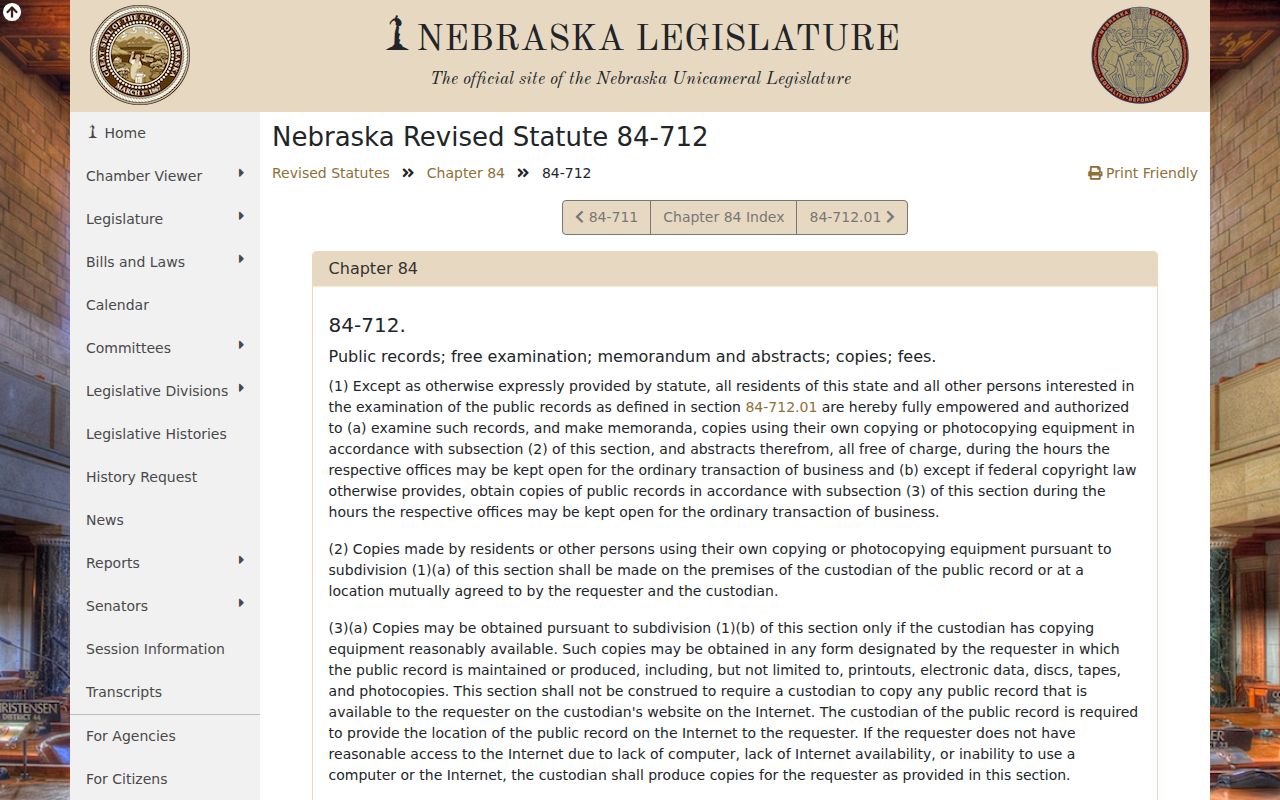
This page grounds the request process in Nebraska law, rather than in a commercial search service.
The Legislature's public-record definition page explains the broad policy.
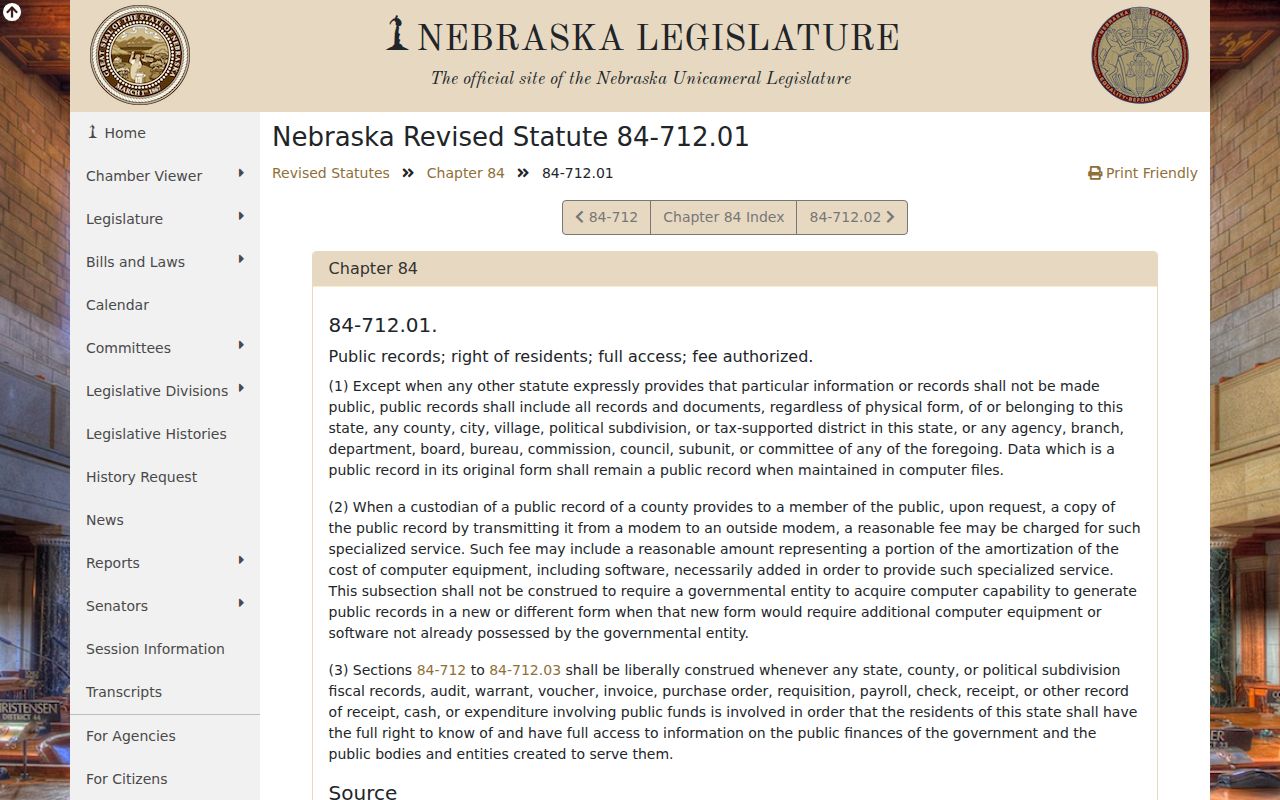
Together, the two official sources show why the right follows the government custodian even when Brule has no local web portal.
Brule PCH and Court Records Differ
NSP PCH is a $30 Nebraska RAP product built from fingerprint-supported adult arrests and reported dispositions. It is not Brule-only, does not cover other states, and may omit entries under public-dissemination rules. JUSTICE is a court index with filed charges, events, and outcomes. An agency report supplies the event narrative.
Use PCH for a broader Nebraska history and the court file for what was actually filed and decided. Use the source-agency report for the event itself. The Keith County court case lookup provides more detail on the county and district court split.
Brule Custody Location Can Mislead
Keith County Jail's Ogallala address is a custody fact, not proof that an event occurred there. The jail accepts adults from Keith, Perkins, and Arthur Counties. A person arrested near Brule can be held beside someone whose case belongs to another county. Always read the arresting agency and court county before tying a roster entry to Brule.
The custody path also changes over time. The county jail covers local detention and pretrial custody. A person sentenced to Nebraska prison moves into the Nebraska Department of Correctional Services system and should be searched through the NDCS locator. VINE can supplement participating custody notifications but does not replace the court docket or prove every hearing outcome.
When the current roster does not answer the question, call the jail. When the issue is the underlying event, contact the investigating agency. When the issue is the charge or sentence, use JUSTICE and the clerk. That three-part check avoids treating one brief custody entry as a full Brule criminal record.
Reading Brule Criminal Record Terms
Words that look alike can mark very different stages. An arrest allegation is an officer's enforcement action. A complaint is a sworn charging allegation that can open a county-court case. An information is a prosecutor-filed felony charging document in district court. A disposition is the outcome of a particular charge, not just the last line on a result list.
- Dismissal
- A case or count ends without conviction, though the reason and chance of refiling can vary.
- Acquittal
- A not-guilty result after adjudication.
- Bench warrant
- A court arrest order often tied to failure to appear or comply.
- Sealing
- A restriction on ordinary access that preserves the government record for authorized use.
Nebraska's set-aside remedy does not erase a valid conviction. Section 29-3523 can limit public dissemination of certain non-conviction arrest entries after statutory conditions are met. Those rules explain why an older Brule incident may be present at the source office while absent from ordinary statewide output.
A person checking their own Brule-related record should preserve the full paper trail. Keep the agency report number, booking date, court caption, case number, disposition, and any signed relief order. If the court entry is wrong, ask the clerk to correct its source data. If the statewide result is missing a disposition, contact the court or prosecutor that reported it because NSP requires corrections from the originating partner. After a change, obtain a fresh PCH result and a new certified court copy. Different Brule record channels may update on different days.
When an access result is blank, check spelling and middle initials before drawing a conclusion. Juvenile information, sealed cases, confidential documents, missing fingerprints, public-dissemination limits, and delayed source reports can all affect what appears. A blank Brule search is a prompt to verify the custodian, not proof that no government file exists.
Brule Record Access Rules
Direct each Brule request to the office that maintains the original. Describe the record, a narrow date range, event location, known name, report or case number, desired format, and whether inspection will suffice. Ask for an estimate before extensive search or redaction work. Nebraska permits reasonable actual added costs, but no Keith County fee table or Brule-specific form was found.
Key Statutes:
Neb. Rev. Stat. §84-712 gives the general inspection and copying right.
Neb. Rev. Stat. §84-712.03 supplies enforcement routes after a denial.
Neb. Rev. Stat. §29-3523 limits dissemination of specified non-conviction arrest entries.
Active investigations, juvenile material, victim identifiers, medical or security facts, and confidential court information may be withheld or redacted. Ask the custodian to identify the legal basis for a denial.